
INDO-EUROPEAN AND SEMITIC INVASIONS IN ASIA
“There are noticeable analogies between the indo European and the Semitic expansion. Both groups were originally nomadic herders who lived around the first points of civilization; both migrated thousands of kilometres conquering the largest agricultural and urban civilizations (in Mesopotamia the first Semitic waves substituted the Sumerians); Both burst into Asia Minor and the Near East approximately at the same time, during the 3rd millennium BC (Seemingly, the indo European Hittites and the Semitic Assyrians met at Kanes, in Central Anatolia, 1900 BC);but more notably, both Indo Europeans and Semites had rigid androcratic social structures. In their rites, they frequently invoked the gods of the tribe, war and conquest. Also were very similar the social and spiritual conflicts generated by the encounter/clash with the populations (agricultural and gilanic) who lived in Europe and Near East at the time of their invasions. Mesopotamia still preserves the memory of a time of peace and abundance abruptly interrupted; like the Summerians, who worshipped a Creator Goddess, akin to the goddess of the Elamites. […] The indo Europeans are not close relatives of the Semites, as it proves their distant original places. Nevertheless, the oppositions ‘androcratic’ versus ‘matrifocal, ‘livestock’ versus ’agriculture’, ‘nomad’ versus ‘urban’ defines a fundamental polarization between Indo Europeans and Semites at one end, and the populations of Neolithic Europe, Pre- Semitic Near East and Pre-Aryan India at the other.” Gianluca Bocci & mauro Ceruti, "El sentido de la historia"
Indo-Europeans:
In this regions, the same worldview around a Mother Goddess figure as the personification of nature, presides the pantheons of Sumer´s (Innana), Anatolia (Cybele) and Canaan (Asherah). These culture´s symbolic art can be taken as analogous to that of old Europe; besides, women had a prominent spiritual roll, like the renowned Sumer priestess, whose knowledge of astronomy is nowadays still prevalent. Yet, as it happened in the neighbouring Europe, these primeval cultures began to suffer the attacks of the Indo-Europeans.
“From the fourth millennium BC onwards, Indo-European tribes, in ever-increasing numbers, forced their way into Mesopotamia, Anatolia, and lands stretching eastwards to the Indus Valley. At the same time Semitic tribes moved into Mesopotamia and Canaan from the Syro-Arabian desert.[…] Wherever they penetrated, they established themselves as the ruling caste and their appearance is marked by a trail of devastation: in Anatolia alone some 300 cities were sacked and burned, among them Troy (2300 BC) and this pattern was repeated from Greece to the Indus Valley. […] The echo of the mythology of war, which resounds in the Mahabharata as it does in the Iliad and the Old Testament, descends from this Bronze Age migrations.
The Aryans were predominantly a society of warriors: ‘They were polygamous, patriarchal, proud of their genealogies, tent dwellers, filthy and tough’ (Campbell, Oriental mythology). They herded cattle, rode horses and invented the spoked wheel and light chariots about 2000-1750 BC. They buried their tribal leaders beneath a mound, together with sacrificed attendants and horses, as the Kurgans had done before them. They worshiped sky gods, particularly the gods of lightning, storm, wind, sun and fire.[…] A Sumerian scribe, writing about 2100 BC, may have described them when he wrote of the devastation wrought by ‘a host whose onslaught was like a hurricane, people who had never known a city’. They sight of these men welded to their horses must have terrified the people they swept the people they swept down upon, giving the image of the centaur or man-horse." Anne Baring and Jules Cashford, ‘The myth of the goddess’.
Semitic tribes:
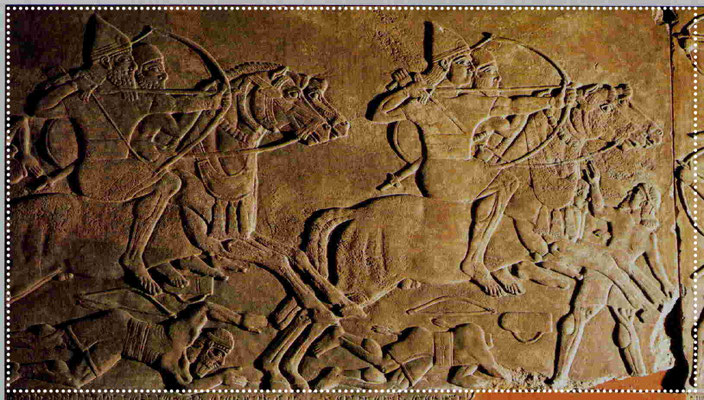
The Semitic people ( Akkadians, Assyrians, Hyksos and Hebrews), whose common origin lies in the Arab desert, can be consider the world´s second focal point of expansion of the primitive patriarchal peoples, and whose worldview gives rise to the anthropocentric thinking that currently prevails in human society. The parallelism with the Indo Europeans are amazing: they are nomadic herders (sheep and goat) with no agricultural practices, they have domesticated the camel (which they can make long distances with) instead of the horse. They are patriarchal, hierarchical, they worship male gods,...
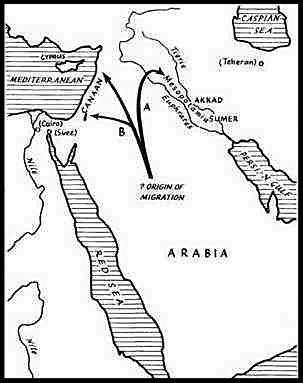
“The Aryans were not the only tribes to threaten the Goddess culture. To the west of Mesopotamia is a vast desert, reaching from Syria in the north to the southern tip of Arabia in the south. It was this region, contrasting so radically with the fertile upland valleys and the lands nourished by the large rivers, that was the matrix from which emerged all the Semitic tribes known and named during the Bronze and Iron ages.
Among these were the Akkadians, who settled in the north of Sumer and, eventually, under their King Sargon (2300 BC), gained control of the southern cities as well; also the Amoritic Babylonian, whose King Hammurabi (1800 BC) is famous for his code of law.
Another group of the Amorites conquered the city of Jericho about 1450 BC, leaving it in ruins; they were succeeded by the Canaanites. The Hebrews in their turn conquered the Canaanites but succumbed to the Assyrians (580 BC), who had seized Babylon in 1100 BC and extended their huge empire over their terrified neighbours.
But long before they became known by their tribal names, the Semites had migrated to Mesopotamia with their herds of sheep and goats, and perhaps merging with the inhabitants in earlier times more peacefully than their successors. The gods of the Semites dwelt in the clouds and on mountain tops, and hurled thunderbolts like the gods of Aryans. But they also had the character of tribal gods, each protective of a specific tribal group and, later, of a city.
Both invading peoples introduced the idea of an opposition between the powers of light and darkness, imposing this polarity on the older view in which the whole contained light and darkness in an ever-changing relationship. In both mythologies there is evidence of a desacralization of nature and of human life, which is starkly contrasted with the attitude of the Neolithic farmer, living close to the soil and to the rhythmic laws of the Goddess as immanent in all life." Anne Baring and Jules Cashford, ‘The Myth of the Goddess’
a) Canaan:
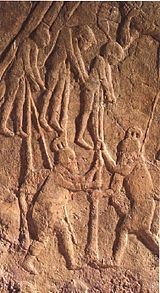
The Semitic invasions of land of Canaan (Palestine, Syria, Jordan and Lebanon) are described in the Old Testament and represent a testimony of how these first patriarchal peoples conceived the world.
“Whether or not, the book of Joshua, with its fierce tribalism, describes what actually took place when the Hebrews entered Canaan, it must reflect the values of the Hebrews who recorded it. The deficient morality of Yahweh becomes more understandable when his commands are taken, not as divine revelations, but as ‘revelations’ of Iron Age values and patriarchal customs reflected in the behaviour of kings, priests and prophets. Jehu, for example, was praised by Yahweh for having murdered the remnant of the former king Ahab´s household and for riding Israel from the entire priesthood of Baal – inviting them to celebrate in the temple and then ordering their massacre( 2 Kgs. 10:0). Elijah (c. 860 BC) supervised the murder of the 450 priests of Baal:
‘Take the prophets of Baal, let not one escape. And they took them and Elijah brought them down to the brook Kishon and slew them there. (1 Kgs. 18:40)’
Episodes like this were used, consciously or unconsciously, to justify the brutality of war waged against an ‘evil’ enemy. Not surprisingly, this model of conduct has greatly influenced Christianity and Islam, which looks upon the Old Testament as divine revelation. Wherever a teaching did not agree with the ‘law of God’, its exponents could be persecuted. The Levite priests apparently exempted themselves, as later did the Christian and Islamic priesthood, from the commandment they believed to be sent by God: ‘Thou shalt not kill’. The law of life´s sacrality was not observed when it was a question of infringement of religious doctrine or the threat of a tribal enemy. New kinds of ritual sacrifice in which murder was justified, such as the stoning and crucifixion of prophets or the torturing and burning of heretics, appear wherever these archaic values went unchallenged. The idea of the ‘Holy war’ waged in Yahweh´s name against the unbelievers and ‘the wicked’ has echoed down the ages in Christian Crusades, the persecution of ‘heretics’, ‘witches’ and ‘enemies of God’.“ Anne Baring and Jules Cashford, ‘The Myth of the Goddess’
To get a clearer idea of the Semitic invasions of Canaan let’s take a fragment of the Old Testament:
And the Lord spoke unto Moses... saying,
"Speak unto the children of Israel, and say unto them,: When ye are passed over Jordan into the land of Canaan: Then ye shall drive out all the inhabitants of the lan from before you, and destroy all their pictures, and destroy all their molten images,and quite pluck down all their higher places:. And ye shall dispossess the inhabitants of the land, and dwell there in: for I have given you the land to possess it."
b) Babylonian and Assyrian Empires:
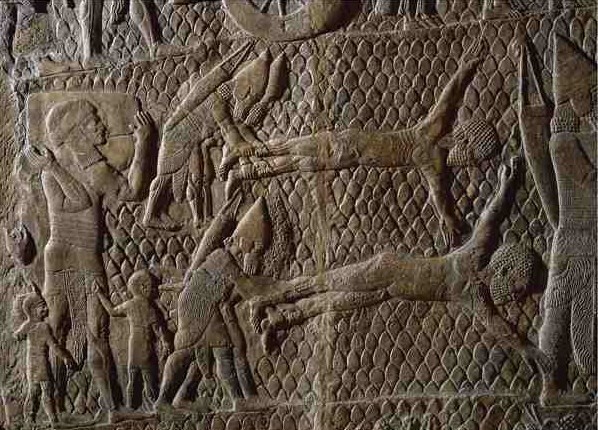
[…] What, in the history books of the early part of this century, used to be admired as the ‘great age’ of the Babylonian and Assyrian Empires was marked by the most barbarous cruelty: the flaying alive of bodies, gouging out of eyes and cutting off of limbs, the murder of thousands of prisoners,[…] This, more than anything else, created a compulsion to aggression. The majority of men had to be warriors. They defended their community, avenged the dead and brought glory to the family name. The king, in particular, had to be a mighty warrior, one like David, of whom they sang one to another in dances, saying: ‘Saul hath slain his thousands, and David his ten thousands.’ […]Cruelty became a virtue and barbarism a way of life. War was regarded as natural and right, the royal road for a man to follow if he were to serve his gods, his king and his country (the rhythms are familiar).The ideal of conquest forged the bond of a tribal consciousness, pre-empting the otherwise universal reflections of art, as can be seen in the seemingly endless lines of identical warriors carved on Assyrian tablets dedicated to destruction.” Anne Baring an Jules Cashford, ‘The myth of the goddess’.
As a testimony of the brutality, thus spoke Sennacherib, king of Assyria (704-681 BC), after the conquest of Babylon:
“I didn´t spare a single one, nor young nor old. I filled the wide streets of the city with their corpses […] the wealth of this city: silver, gold, precious stones, personal effects, belongings,...were the booty of my people, who took them as theirs. The gods that dwell at its heart were captured and crushed by the hands of my people, who took away their effects and belongings,”
A new god legitimated the barbarity: Erra, Assyrian god of death. This is an extract of the epic poem about such bloodthirsty god:
“Respect no god! Fear no man!
Bring death to young and old,
to infants and children. Leave none alive!”
And so spoke Ashurbanipal, grandson of Sennacherib (668-626 BC):
“Then, as an offering to Sennacherib, I ploughed this people alive. Their flesh I fed to dogs, pigs, vultures, eagles; […] I took the corpses of those who were defeated by Erra and by famine and hunger […] those bones I took from Babylon, Kuta and Sippar, and cast them off into piles.”
b) Indus Valley:
The Dravidian people, in the Indus valley and the bordering areas northwest of the Hindustan, was a Neolithic civilization that reached a high level of development, as we can see by the archaeological findings in Harappa (Punjab) an Mohenjo-Daro (Sindh). The architecture and urban planning of these cities were certainly astonishing for their time; in fact, Mohenjo-Daro had a system of aqueducts and gutters that, in the archaeologists’ opinion, had nothing to envy nowadays western cities. Once again, we find analogous symbolic art to that of old Europe, and once again we find Indo European (Arians) people starting to move into the peaceful agricultural communities of the Indus Valley and originating the Indian Caste System.
“At that moment, which might have been the most important (and perhaps most ill-fated) for the development India, the comparatively peaceful and highly sophisticated Dravidians (besides the other peoples that inhabited the Hindustan) were invaded and conquered by the warring and rude Indo Europeans. Sad as this event may have been the result of the interaction between the brilliant conquered ones and the barbarian conquers gave birth to the cultural synthesis that through the last millennia became the Indian civilization. […] The caste system derives from the Indo Europeans´ necessity to preserve the privileges obtained with the conquest over the pre-Indo Europeans. The supreme caste, the Brahmin, held priestly functions; it gathered those who had purest Indo European blood. This was justified in the Rig Veda (X.90) which says they came out of Purusha´s mouth, the universal soul. The next caste below, Kshatriya, became the nobility who held the state and war functions, gathered a lesser proportion of Indo European blood. The Rig Veda grants their privileges saying that they came from the arms of Purusha. The Vaishya caste is made up of traders and craftsmen with more pre Indo European blood, which came out of Purusha´s legs. Then is the Shudra, servants an farmers, with again less Indo European blood. The purely non indo Europeans, who didn´t come from the division of the universal soul, were declared ‘untouchable’. The lack of divine origin disabled them for religious practice, hence, any contact with them would make any indo European loose his/her caste.” Elías Carriles.
The Dravidian people had a matrifocal social system. The Arians called them “the people of the land and the snake”. Arians called themselves “people of the sky”. According to Indian mythology Indra, god of the sky, decapitated the Dravidian goddess Danu. And Indra´s son, the god Vrta beheaded the two snakes, creators of the Dravidian people. From then on, the indigenous population has been the lowest caste: “the untouchable ones”.
The Rig Veda, valuable testimony of those times, tells of the victories of the corn-coloured Arians (Indo Europeans) over the dark-skinned people. That turn took place more than 3000 year ago, after 1500 BC. Yet, it pervades the modern Indian civilization. It has caused the most relevant linguistic division in the subcontinent, with the Indo European languages being spoken in Northern India and the Dravidian languages prevailing in the South. Its effects are still present in the characteristic features of the Indian religion.” Ceruti and Bochi.
“The Vedic religion is connected with the cultural outcome of the nomadic indo European invaders and the Indus Valley´s civilization. It consists of the combination of native and Indo European elements and original elements of hybridization. The Veda or ‘knowledge’ are a compilation of hymns written at different times and by different authors, which resumes a centenary process threaded by revelations (Śrutiin Sanskrit).The Vedic deities continue the characteristic male predominance of the Aryan religious pantheon.... The supremacy of Indra, as warrior, states at a superstructural level his analogy with the warrior caste (Kshatrya) in the social system of the time.” Ismael Apud and Mauro Clara.
Hence, the Rig Veda gathers the testimony of this whole historic process. An extract of the hymns reads as follows:
Like a stormy cloud,
The armed hero bursts into the chaos of battle.
Glory to thee and unscathed body!
May thy stout armour protect thee!
We want to get cattle with our bow.
We shall win battle after battle with our bow.
With our bow, terror of the enemy, we trust we shall conquer the lands.